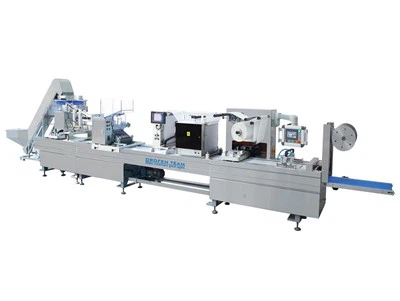

INJECTION PEN FINAL ASSEMBLY SYSTEM
CARTRIDGE INTEGRATION & LABELING PLATFORM | 2-CELL INTEGRATED ARCHITECTURE
|
160
PARTS / MIN
|
≥85%
TARGET OEE
|
≥98%
PRODUCT YIELD
|
≥1.33
Cpk
|
Technical Specifications
| System Architecture | 2-Cell integrated platform (Cell 1: Assembly + Inspection | Cell 2: Labeling + Palletizing) | 24 stations total |
| Production Speed | 160 PPM (single pen platform) | 84 PPM (dual pen-type compatibility mode) | Configurable to 80 PPM |
| Format Flexibility | Recipe-driven changeover: 60IU / 80IU, 1.5 mL / 3.0 mL | 30–45 min by 2 technicians |
| Servo Axes | 26 independent servo axes (Bosch Rexroth + Festo) |
| Force Monitoring | KISTLER load cells | 100% force-displacement curve per unit | Auto-reject on deviation |
| Vision System | Keyence | Cartridge variant verification (60IU vs 80IU) | Zero-position & label inspection |
| LVDT Measurement | Keyence LVDT | Cartridge-to-screw gap measurement | Servo pre-spinning without overpressure |
| Labeling | Thermal transfer | 4+ lines dynamic print (Lot, Expiry) | 100% vision verification | Auto-reject |
| Palletizing | X/Y/Z gantry | 240 pcs/tray | Automatic batch separation |
| Continuous Operation | ≥ 20 hours/day, 300 days/year | Equipment lifespan ≥ 20 years |
| Tooling Durability | < 0.05 mm wear over 5-year service life |
| Noise Level | < 75 dB(A) at 1 m |
Control Platform & Compliance
| PLC | Siemens S7-1500 (CPU 1517-3PN/DP) | TIA Portal V19 |
| HMI | Advantech PPC-618W-PTA industrial panel (bilingual) |
| Network | Profinet real-time | OPC-UA for MES/SCADA | NTP time sync |
| Data Integrity | 21 CFR Part 11 | 5-element audit trail | Electronic batch records | PDF export |
| Disaster Recovery | UPS protection | Full state backup | Auto-resume to pre-failure state |
| Validation | GAMP 5 V-model | FAT (IT/OT/Run) | SAT | IQ/OQ/PQ | RTM |
| Safety | CE 2006/42/EC | ISO 13849 PL-d interlocks | E-stop < 0.5 s |
| Source Code | Open architecture - PLC/HMI/Vision code delivered without password protection |
Assembly Process - 160 PPM
Component Feeding & Variant Verification: Drug cartridge, holder, pre-assembled pen body, and cap feeding. Keyence vision confirms cartridge orientation and dose button color (60IU vs 80IU) to prevent SKU cross-contamination.
LVDT Gap Measurement & Servo Pre-Spinning: Keyence LVDT measures cartridge plunger-to-screw gap at micron level. Servo mechanism pre-spins the screw rod to engage without overpressure. Speed and rotation count are recipe-configurable (1.5 mL / 3.0 mL).
KISTLER Force-Monitored Pressing: Servo-driven press joins pen body to cartridge holder. KISTLER load cells generate real-time force-displacement curves. Units deviating from validated recipe window are auto-rejected.
Final Verification & Cap Assembly: Vision confirms dose indicator at "0" position. Pen cap pressed with presence verification. Built-in challenge part routines validate all sensors and rejection mechanisms before batch production.
Integrated High-Speed Labeling: Thermal transfer printing of dynamic batch data (Lot, Expiry). Labels positioned below dose window with 3-point vision verification (0mg mark, pen clip, label). 100% non-conforming labels auto-rejected with classified counting.
GMP Material Selection
| Product Contact | AISI 304 (0Cr19Ni9) austenitic stainless steel |
| High-Wear Parts | AISI 440 (7Cr17) chromium hardened stainless steel |
| Polymers | Medical-grade PEEK + Acetal Copolymer (POM) |
| Frame | Carbon steel welded frame + full SS304 sheet metal enclosure |
| Seals | PTFE / EPDM (FDA-compliant) |
| Lubrication | 100% food-grade, strictly isolated from product contact areas |
Project Delivery: 10–12 Months from Contract
| Design & Engineering | Collaborative design reviews + eFMEA risk assessment |
| FAT | Complete IT, OT, and Run testing at DROFEN facility |
| SAT | On-site acceptance with actual customer production materials |
| Training | Comprehensive operation & maintenance (FAT + SAT period) |
| Warranty | 2-year standard | 8-hour remote response | 48-hour on-site arrival |
| Source Code | Open architecture - all PLC/HMI/Vision code without password protection |
Premium Component Ecosystem
| Siemens | Rexroth | Keyence | KISTLER | Festo |
| PLC & HMI | Servo Drives | Vision & LVDT | Force Sensors | Pneumatics |
2-Cell Architecture Overview
| Cell | Function | Key Processes |
| Cell 1 | Assembly & Inspection | Component feeding, variant verification, LVDT measurement, servo pre-spinning, KISTLER force-monitored pressing, cap assembly, dose indicator verification |
| Cell 2 | Labeling & Palletizing | Thermal transfer printing, 3-point label verification, auto-reject, X/Y/Z gantry palletizing (240 pcs/tray), batch separation |
| Integration | Cell-to-Cell | Ethernet-based real-time communication | Unified Siemens PLC control | Synchronized at 160 PPM |
Architecture Comparison: Linear Cam-Driven vs Rotary Indexing
| Dimension | Linear Cam-Driven Pallet Transfer | Rotary Indexing Table (Servo-Driven) |
| Drive Principle | Mechanical cam (main shaft) + servo on critical stations (press-fit, winding) | Independent servo motor per station |
| Motion Synchronization | Inherent mechanical synchronization via cam profile - deterministic timing | Electronic synchronization via PLC - software-dependent timing |
| Scalability | Modular - add cells or stations without redesigning existing structure | Fixed by dial diameter - adding stations requires new dial or multi-dial |
| Speed Potential | 160 PPM (single pallet per station) | Typically 20–30 cycles/min × multi-up nests to achieve equivalent throughput |
| Failure Isolation | Cell-based - one cell fault does not necessarily stop entire line | Single dial - any station fault stops all stations |
| Maintenance Complexity | Fewer electronic components - cam profiles require no tuning once validated | More servo drives, encoders, and cables - higher spare parts inventory |
| Long-Term Reliability | Proven >20-year mechanical lifespan - minimal degradation with proper lubrication | Servo drive lifecycle 8–12 years - periodic replacement required |
| Footprint | Linear layout - longer but narrower, fits corridor-style cleanrooms | Compact circular - shorter but wider, requires open-plan cleanroom |
| Format Changeover | Recipe-driven - servo parameters + cam selection per format (30–45 min) | Tooling change per nest + servo re-parameterization |
| Validation Effort | Deterministic motion - fewer software parameters to validate per IQ/OQ | Each servo axis requires independent parameter validation |
The DROFEN injection pen final assembly system integrates cartridge loading, force-monitored pressing, high-speed labeling, and automatic palletizing into a 2-cell integrated architecture operating at 160 pens per minute. This platform supports insulin pen and GLP-1 pen production with recipe-driven format changeover between 60IU/80IU and 1.5mL/3.0mL configurations in 30–45 minutes. KISTLER load cells generate 100% force-displacement curves per unit, while Keyence vision verifies cartridge variant, dose indicator position, and label placement. Built for pharmaceutical manufacturers and CDMOs requiring 21 CFR Part 11 audit trails, the system delivers ≥85% OEE with ≥20-year equipment lifespan and full open-source code delivery.
Whether configured as a standalone final assembly machine or integrated into a complete final assembly line, the system delivers consistent pharmaceutical-grade output for insulin pen, GLP-1 pen, and injection pen programs.
DROFEN provides turnkey injection pen assembly lines from engineering design through on-site qualification with comprehensive FAT/SAT and IQ/OQ/PQ support.
Related Technical Resources