
A Technical White Paper by DROFEN MACHINERY EQUIPMENT CO., LTD
Author: Jordan Xu, Managing Director
A DROFEN MACHINERY Technical Whitepaper for Pharmaceutical Manufacturers and CDMOs

Executive Summary
The global surge in GLP-1 receptor agonists and modern insulin therapies has created an unprecedented, structural demand for reliable, high-throughput injection pen assembly lines. As biosimilar developers and generic pharmaceutical manufacturers race to capture share in the insulin pen and GLP-1 pen injector markets, the true competitive bottleneck is shifting downstream: from sterile cartridge filling to the high-precision assembly, functional testing, and validation of the finished pen device.
This whitepaper provides an in-depth engineering analysis of the injection pen assembly line. It draws a clear distinction between the pen injector pre-assembly machine - also known as the sub-assembly machine -(which builds the empty device from molded components) and the insulin pen final assembly line (which loads the filled cartridge into the device), because the two process modules address fundamentally different risks and require different validation logic. It examines the technical heart of any credible pen assembly machine - force-displacement monitoring, torque control, 100% in-line functional testing to ISO 11608, AI vision inspection, gentle glass handling, and tool-less changeover - and explains why sustained OEE and zero-defect output matter far more than a demo-day units-per-minute figure.
Finally, this paper explains why fragmented, multi-vendor sourcing is the single largest cause of schedule and cost overruns in pen injector projects, and how DROFEN MACHINERY's integrated model - equipment delivery, proven pen platform support, and complete regulatory validation support - allows manufacturers to compress time-to-market, pass EU and US GMP audits, and industrialize insulin and GLP-1 pen products with confidence. Our goal is straightforward: to deliver a validated production system that performs in commercial reality, not only in a factory demonstration.
Whether you are evaluating a single insulin pen assembly machine or planning a complete integrated line, this guide provides the engineering foundation for informed equipment selection and successful GMP validation.
1. Introduction: Why the Injection Pen Has Become the Battleground
The global pharmaceutical landscape is undergoing a profound structural transformation. As biologic therapies - particularly GLP-1 receptor agonists and advanced long-acting insulin formulations - move to the center of chronic-disease treatment, the method of drug delivery has become as strategically important as the molecule itself. The injection pen is no longer a convenience accessory bolted onto a vial; it is an integral drug-device combination product whose reliability directly determines patient compliance, dosing accuracy, and therapeutic outcomes.
For pharmaceutical manufacturers, this shift forces a change in mindset. Companies that have historically excelled at sterile liquid filling now find that mastering the cartridge filling line is only the entry ticket. The genuine bottleneck in bringing a modern injectable to market lies further down the value chain, in the complex, high-tolerance mechanical assembly of the pen injector itself. A drug that is perfectly filled but housed in a poorly assembled pen - one that under-doses, over-doses, jams, or fails a functional test - cannot reach the patient, and cannot pass a regulatory audit.
This whitepaper is written for engineering directors, project managers, and QA leaders who are responsible for specifying, procuring, or upgrading an injection pen assembly line. It has three objectives. First, to remove the persistent terminology confusion between pre-assembly (sub-assembly machine) and final assembly, which routinely causes equipment mis-specification. Second, to explain, in concrete engineering terms, the technical requirements that separate a line that merely runs from a line that survives commercial production and GMP scrutiny. Third, to present a project-delivery philosophy - the turnkey system provider model - that consistently reduces risk for manufacturers entering the insulin and GLP-1 pen space. Throughout, the perspective is that of a practical equipment engineer who has seen where real projects succeed and where they quietly fail.
2. Market Dynamics: The Demand Behind Injection Pen Assembly Equipment
The demand driver is unmistakable. The global injection pen and auto-injector market is expanding at a compound annual growth rate of roughly eleven percent and is widely projected to move from the tens of billions of dollars today toward well over one hundred billion dollars within the coming decade. Underpinning this is the extraordinary growth of GLP-1 therapies for diabetes and weight management, alongside the enduring, price-sensitive global demand for insulin pens.
Two forces make this a manufacturing opportunity rather than merely a pharmacological one. The first is patent expiry. As the compound and formulation protections around leading GLP-1 and insulin products lapse over the coming years, a large wave of biosimilar and generic development is moving into emerging markets - India, China, South Korea, the Middle East, and Southeast Asia in particular. The second is national policy. Local-production incentives such as India's PLI scheme, Saudi Arabia's Vision 2030 localization targets, and various local-content requirements across Asia are actively pushing domestic manufacturers to invest in device assembly capacity at home rather than importing finished pens.
The practical consequence is that a large number of pharmaceutical companies that have never before assembled a drug-device combination product now need an insulin pen assembly line or a GLP-1 pen injector assembly line, and they need it quickly. In this environment, speed to market is the ultimate competitive advantage. Every month of delay in equipment procurement, device validation, or process debugging translates directly into lost first-mover revenue in a market where the earliest credible entrant often captures disproportionate share.
2.2 Disposable vs. Reusable: Why Device Format Drives Equipment Design
Not all pens are assembled the same way, and equipment must be specified against the intended device format. Disposable, single-use prefilled pens dominate the market by volume, driven by their convenience and the elimination of patient handling errors. Reusable, cartridge-based pens hold a meaningful minority share, while spring-loaded auto-injectors - though smaller in absolute terms - are the fastest-growing segment as self-administration expands.
Each format imposes distinct assembly demands. Disposable pens require extremely high-speed, low-cost-per-unit assembly with a fully integrated cartridge-loading step. Reusable pens demand more robust mechanical tolerances and repeated-use durability testing. Auto-injectors introduce energized components - springs and, in some designs, actuation mechanisms - that require additional safety interlocks and specialized functional testing. A credible equipment partner must understand these differences at the design stage, because retrofitting a line built for one format to handle another is expensive and rarely fully successful.
2.3 The Hidden Cost of Fragmented Sourcing
Historically, a pharmaceutical company would source the pen device design from one vendor, purchase the pre-assembly equipment from a second, buy the final assembly line from a third, and then attempt to stitch these together with in-house engineering and a fourth-party validation consultant. On paper this appears to optimize each purchase; in practice it is the single most common cause of failed or delayed pen projects.
Fragmented sourcing produces three recurring failure modes. The first is integration failure, in which the dimensional tolerances of the molded plastic components - sourced against the device vendor's drawings - do not match the gripping, orienting, and pressing assumptions built into the assembly machine. The second is validation misalignment, where the IQ, OQ, and PQ documentation from multiple suppliers uses inconsistent formats, incompatible risk assessments, and conflicting data-integrity assumptions, forcing the customer to reconcile them under audit pressure. The third is commercial erosion, where the hidden costs of extended troubleshooting, prolonged FAT and SAT phases, and a delayed production start quietly consume the savings that fragmented purchasing was supposed to deliver.
2.4 The System-Provider Response
To eliminate these failure modes, the industry is converging on the system-provider model. Under this approach, a single partner takes responsibility for the equipment, the device platform compatibility, and the validation documentation as one coherent deliverable. DROFEN MACHINERY is built around exactly this philosophy. Rather than positioning itself as a machine vendor, DROFEN acts as a project-realization partner: it delivers the injection pen assembly line, supports a proven and ready-to-validate pen device platform, and provides the regulatory and validation depth required to move from concept to commercial, audit-ready production. The remainder of this whitepaper explains what that requires in engineering terms.
2.5 Where the Demand Is Concentrated: A Regional View
Understanding where injection pen assembly demand is concentrated helps explain why the system-provider model is resonating now. India, the world's largest generic-drug producer by volume, is investing heavily in domestic device assembly capacity, encouraged by production-linked incentives and a rapidly growing internal diabetes and metabolic-disease population; Indian manufacturers are among the most active in preparing insulin and GLP-1 pen lines. Across the Gulf, Saudi Arabia's localization agenda explicitly targets a large increase in domestic pharmaceutical production, and insulin is a designated strategic medicine, which pulls pen assembly capability into the Kingdom. The wider Gulf region, with Dubai as a re-export hub, extends this demand. In Southeast Asia, local-content requirements are pushing Indonesian and neighboring manufacturers toward in-country assembly, while Turkey's substantial domestic manufacturing base is modernizing toward device production. Across all of these markets the common thread is the same: ambitious manufacturers that need to stand up validated pen assembly capacity quickly, at a capital cost their business case can bear, and with the validation support to satisfy both their domestic regulator and the export markets they aspire to reach. This is precisely the customer DROFEN is built to serve.
3. Clarifying the Terminology: Pre-assembly vs. Final Assembly
A surprising amount of project risk originates in loose terminology. When "pen assembly" is used as a single undifferentiated phrase in a URS or a purchase specification, the resulting equipment is almost always mis-scoped. It is therefore essential to define the two process modules precisely and to treat them, as experienced engineers do, as separate risk domains.
The pen injector pre-assembly machine - also described as pen component assembly, injector sub-assembly equipment, or a plastic pen body assembly line - is responsible for building the empty mechanical device from its individual molded and metal components.
Its input is a set of individual parts: the pen body or front housing, the rear housing, the dose knob or dial, the drive sleeve, the piston rod or lead screw, the number sleeve, springs, and various clips and seals. Its process is high-speed mechanical assembly, typically executed through a combination of cam-driven motion for repetitive high-speed stations and servo-controlled motion for stations that require programmable force or position. Components are oriented by feeders, then snapped, pressed, screwed, or staked together in a precisely sequenced order. Its output is a complete, mechanically functional, but empty pen sub-assembly - a device that can set and deliver a simulated dose, but that does not yet contain any drug product.
Because no sterile drug is exposed during pre-assembly, this module typically operates in a controlled but less stringent cleanroom environment, commonly ISO 8 or ISO 7 depending on the product and market. The dominant technical risks here are mechanical: component feeding reliability, orientation accuracy, snap-fit engagement force, and the cumulative tolerance stack-up across many joined parts.
The insulin pen final assembly line is where the pharmaceutical product meets the medical device, and it is the point at which pharmaceutical QA and medical-device QA intersect. This intersection is precisely why final assembly carries the heaviest regulatory and technical burden.
Its input is twofold: the pre-assembled pen body arriving from the pre-assembly machine, and the filled, sealed glass cartridge arriving from the cartridge filling and closing line. Its process centers on the delicate insertion of the fragile glass cartridge into the pen body, the correct engagement of the piston rod against the cartridge stopper, and the final mechanical locking, snapping, or crimping that secures the finished device. Its output is the finished, ready-to-use, labeled injection pen containing the drug.
The environment for final assembly must satisfy GMP requirements appropriate to handling a filled primary container, with defined controls to prevent contamination and to protect the integrity of the cartridge closure system during handling. The dominant technical risks shift from pure mechanics to a combination of fragile-glass protection, dose-accuracy verification, and complete data traceability for a serialized, market-bound medical device.
The strategic implication is clear. Pre-assembly and final assembly should be specified, quoted, validated, and risk-assessed as distinct modules that happen to be integrated, not as a single monolithic machine. DROFEN provides comprehensive solutions across both, but consistently guides customers to evaluate them as separate process modules, because that is how robust, audit-ready lines are actually built.
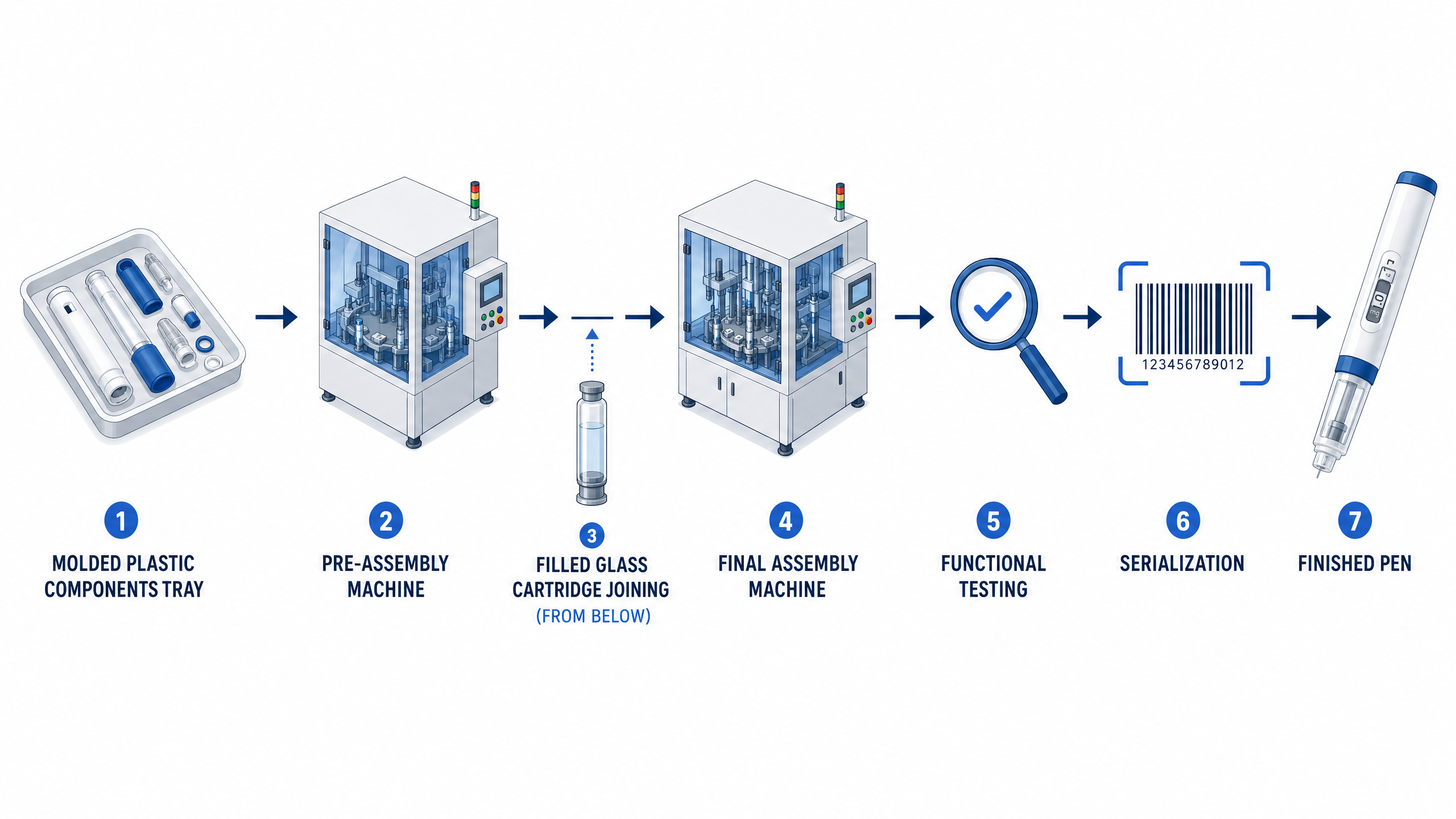
3.3 The Complete Process Flow, Step by Step
To make the two modules concrete, it helps to walk the full path a component takes from an injection-molding tray to a finished, boxed pen. In pre-assembly, molded parts are loaded into vibratory or centrifugal feeders that singulate and orient each component. Orientation verification confirms that no part enters the assembly stream upside down or reversed. Stations then join components in a validated sequence: the drive sleeve is inserted into the housing, the lead screw or piston rod is threaded or pressed into the drive sleeve, the dose knob and number sleeve are engaged, and springs and clips are set. Interleaved between mechanical stations are in-process checks - presence sensors, force monitoring, and vision - so that a defective sub-assembly is caught and rejected before further value is added to it. The output of pre-assembly is buffered and presented to final assembly.
In final assembly, the empty pen body and the filled cartridge converge. The cartridge is transferred gently from its incoming nest, inspected for fill level and cosmetic defects, and oriented. It is then inserted into the pen body under monitored force, and the pen is closed by snapping or crimping the cap or holder in place. The assembled pen proceeds to functional testing, where dose setting, drive advancement, and torque are measured on every unit. It is then laser-coded or labeled for serialization and track-and-trace, given a final vision inspection, and passed to good-product accumulation, while any rejected unit is diverted to a locked reject bin whose count is reconciled against the batch record. Understanding this flow is what allows a buyer to see why each in-line test exists and where each risk is contained.
4. The Engineering Core: Critical Technical Requirements of a Pen Assembly Line
When a manufacturer first evaluates an injection pen assembly line, the opening question is almost always about speed - units per minute, or pens per hour. Speed matters, but it is the wrong headline metric. A line that achieves a high nominal speed during a clean, hand-fed demonstration but cannot sustain that rate under real component variation, shift changes, and continuous operation is worthless in production. The metrics that determine commercial success are sustained Overall Equipment Effectiveness, first-pass yield, and defect containment. This section examines the engineering capabilities that actually decide those outcomes.
4.1 Force and Displacement Monitoring: The Heart of Assembly Quality
Almost every assembly and insertion step in a pen line is, at its physical core, a controlled application of force over a controlled distance. This is simultaneously the most important and the most under-specified requirement in many purchase documents.
The engineering challenge is a narrow process window bounded on both sides. Applying too much force during cartridge insertion can create micro-cracks in the glass - invisible at the point of assembly but capable of propagating into a leak or a catastrophic break in the field. Excessive force during plastic assembly can over-stress snap-fits, deform housings, or shear retaining features. Conversely, insufficient force leaves components incompletely engaged, producing a device that appears assembled but fails mechanically in the patient's hand, sometimes weeks later.

The correct solution is closed-loop force-displacement monitoring on every critical station. High-resolution force sensors, paired with servo-driven actuators and position encoders, allow the control system to record a complete force-versus-displacement curve for every individual assembly stroke, on every single unit - not on a sampling basis. Validated upper and lower limit envelopes are defined for each curve. Any unit whose curve breaks out of its envelope is flagged in real time and automatically diverted to a reject station. This transforms assembly from a blind mechanical action into a measured, documented, and defensible quality operation, and it produces exactly the kind of per-unit process data that a modern GMP audit expects to see.
4.2 100% In-line Functional Testing to ISO 11608
An injection pen is a precision dosing instrument, and its performance is governed by the ISO 11608 family of standards for needle-based injection systems. Functional testing is therefore not an optional refinement; it is a core function of the assembly line, and it must be performed on one hundred percent of units, not on samples.
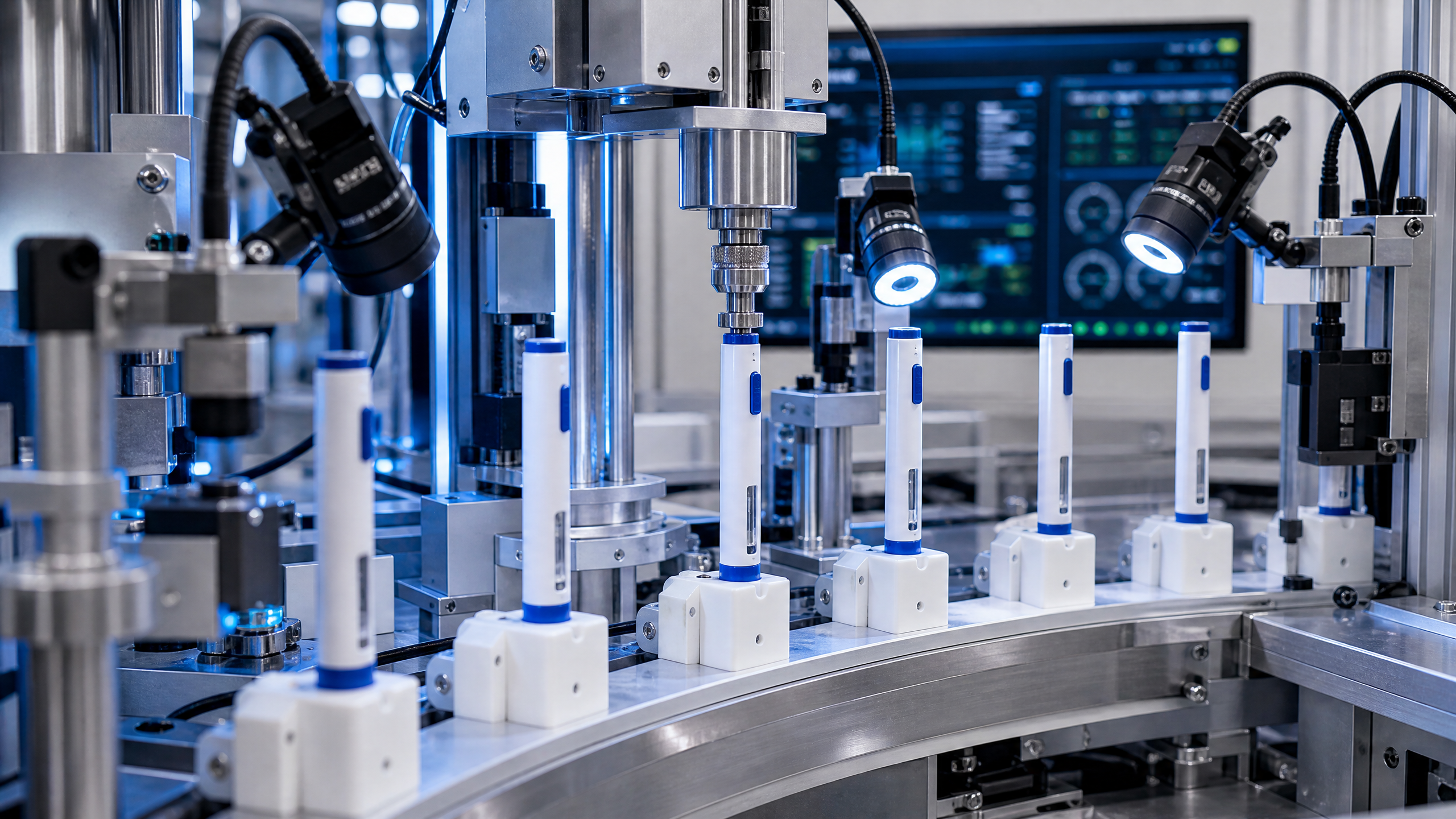
An in-line functional-test station verifying dose setting, drive advancement and dialing torque on 100% of pens, complemented by AI vision inspection cameras.
Dose-setting and dose-delivery verification requires the line to mechanically simulate the patient's interaction with the device. The equipment sets a defined dose, confirms that the dose selector advances correctly, verifies the presence of the correct tactile and audible click feedback where the design specifies it, and measures that the drive mechanism advances the piston by exactly the displacement corresponding to the selected dose. A pen that delivers even slightly more or less than its labeled dose is a patient-safety failure.
Torque testing is equally critical and frequently overlooked. Micro-torque transducers integrated into functional-test stations measure the rotational effort required to dial and to deliver a dose. Torque that is too high renders the pen unusable for the elderly or dexterity-impaired patients who often depend on these devices; torque that is too low can indicate a stripped, mis-assembled, or under-lubricated mechanism. Defining and enforcing a validated torque window is central to both usability and mechanical-integrity assurance.
4.3 AI Vision Inspection: Seeing Every Defect
Vision inspection provides the non-contact quality layer that complements force and functional testing. High-speed cameras, increasingly augmented by AI-based defect-classification algorithms, are deployed at multiple stations along the line to verify that every required component is present and correctly oriented, that colors and printed features match the correct configuration, and that no cosmetic or functional defects - scratches, flash, short-shots, contamination, or label misplacement - are present.
The particular difficulty with pen components is that many are transparent, translucent, or highly reflective, which defeats naive vision approaches. A capable system addresses this through engineered lighting geometry, multi-angle imaging, and trained classification models, and it must keep the inspected unit stationary at the imaging moment so that surface dust or motion does not corrupt the image. When integrated correctly, vision inspection closes the loop that force and torque testing cannot fully cover, catching cosmetic and presence defects that would otherwise reach the patient or the auditor.
4.4 Gentle Handling of the Glass Cartridge
In the final assembly line, the filled glass cartridge is the single most valuable and most fragile item on the machine, and its protection is a defining design constraint. Two principles govern good design here. The first is the elimination of glass-to-metal contact throughout the transport path: pucks, grippers, orienting features, and transfer surfaces that touch the cartridge must be manufactured from qualified polymers rather than bare metal, so that the cartridge cannot be scratched or scored. A scratch is not merely cosmetic; it is a stress concentrator that can initiate a crack.
The second principle is shock and vibration control. The transport system must accelerate and decelerate the cartridges smoothly, avoiding the sudden impacts and cartridge-to-cartridge collisions that can compromise the closure integrity of the rubber stopper and aluminum crimp seal. On lines handling sensitive biologic and peptide formulations, this gentle-handling discipline directly protects product quality, because closure-integrity failures are among the most damaging and hardest-to-detect defects in a finished injectable.
4.5 Tool-less Changeover and Format Flexibility
CDMOs and multi-product manufacturers rarely run a single format forever. A line that is efficient only when dedicated to one pen design is a poor investment for a business that must serve insulin and GLP-1 products, multiple dose volumes, and evolving device generations. Format flexibility is therefore an economic requirement, not a luxury.
DROFEN's design philosophy emphasizes tool-less changeover: quick-release, uniquely-keyed format parts that cannot be installed incorrectly, combined with recipe-driven servo positioning managed through the HMI so that dimensional adjustments are made in software rather than by manual mechanical setting. When executed well, this approach reduces changeover from a multi-hour, error-prone manual exercise to a guided procedure completed in well under an hour, with the added benefit that each recipe is a controlled, version-managed, auditable object rather than an operator's memory.
4.6 Comparing What Matters: A Practical Evaluation Table
The following table summarizes how a buyer should weigh the capabilities discussed above, and why each one matters in production rather than in a demonstration.
|
Capability
|
What It Actually Controls
|
Why It Decides Production Success
|
|
Force-displacement monitoring
|
Glass integrity, snap-fit engagement, assembly completeness
|
Prevents field failures and micro-cracks; produces per-unit audit data
|
|
Functional testing (ISO 11608)
|
Dose accuracy, click feedback, drive advancement
|
Directly protects patient safety and regulatory acceptance
|
|
Torque testing
|
Usability effort, mechanism integrity
|
Ensures device is usable by target patients; detects mis-assembly
|
|
AI vision inspection
|
Component presence, cosmetic and print defects
|
Catches defects that force/torque cannot; hardest on transparent parts
|
|
Gentle glass handling
|
Cartridge surface and closure integrity
|
Protects the highest-value component; prevents closure failures
|
|
Tool-less changeover
|
Multi-format economics, recipe control
|
Sustains OEE across products; makes format changes auditable
|
|
Sustained OEE and yield
|
Real output over time
|
The true measure of line value, unlike demo-day peak speed
|
4.7 Serialization, Track-and-Trace, and Line Integration
Modern regulated markets increasingly require unit-level serialization and traceability, and the assembly line is where the device's identity is first written and verified. A well-designed line integrates laser or inkjet coding, immediate code-verification vision, and aggregation of unit codes into higher packaging levels, all synchronized with the plant's serialization and MES systems through standard interfaces such as OPC-UA. This integration is not a cosmetic add-on; if the serialization step is poorly integrated, it becomes a throughput bottleneck and a data-integrity weak point. Designing serialization and MES connectivity into the line from the beginning - rather than retrofitting it - is another area where an integrated system provider protects both the customer's OEE and the customer's audit position.
5. The Hidden Bottleneck: Regulatory Compliance and Validation
There is a hard truth that experienced project leaders learn, sometimes expensively: a machine that runs flawlessly on the factory floor but fails a GMP audit is a liability, not an asset. For a drug-device combination product bound for regulated markets, the validation documentation and data-integrity architecture are every bit as important as the hardware - and they are the most commonly underestimated part of the project, particularly by lower-cost suppliers who quote only the steel.
5.1 Data Integrity: 21 CFR Part 11 and EU GMP Annex 11
A pen assembly line performing one hundred percent force, torque, functional, and vision testing generates an enormous volume of quality data, and that data must be trustworthy under the ALCOA+ principles: attributable, legible, contemporaneous, original, accurate, and also complete, consistent, enduring, and available. Meeting this standard requires a SCADA or equivalent supervisory system built around compliant record-keeping rather than a simple PLC touchscreen.
Three architectural elements are essential. Electronic batch records must securely capture the force curves, torque values, functional-test results, and vision outcomes for every serialized pen, linking each record to the specific unit and production context. Audit trails must record every operator action, recipe change, parameter modification, and alarm acknowledgment with a secure, tamper-evident time stamp and an electronic signature. And role-based access control must ensure that only authorized, uniquely identified personnel can view or alter critical process parameters, with shared or generic accounts eliminated by design. Together these elements convert the line's raw quality data into defensible, audit-ready evidence.
5.2 The GAMP 5 V-Model and the Validation Master Plan
DROFEN structures its validation support around the ISPE GAMP 5 risk-based V-model, in which every specification on the left side of the "V" is matched to a corresponding verification activity on the right, and every requirement is traceable end to end through a requirements traceability matrix. This discipline is what allows a customer to demonstrate, on demand, that each user requirement has been designed for, built, and objectively tested.
The lifecycle proceeds through defined, documented stages. Design Qualification confirms that the equipment design satisfies the URS and functional specification before fabrication commits the budget. Factory Acceptance Testing, conducted at DROFEN's facility using the customer's actual components, rigorously exercises every in-process control and every rejection pathway before the machine ships - the point at which problems are cheapest to fix. Site Acceptance Testing verifies correct installation and integration in the customer's facility. Installation Qualification documents that all components, utilities, wiring, and instruments are installed correctly and that every measurement instrument carries an ISO 17025-traceable calibration certificate. Operational Qualification exercises the equipment across the limits of its operating parameters to prove stability and correct alarm and reject behavior. Finally, Performance Qualification support accompanies the customer through initial production runs to demonstrate that the complete, integrated process consistently produces conforming devices.
5.3 The Regulatory Reference Matrix
The table below consolidates the principal standards that govern an injection pen assembly line and how each is addressed in a well-executed project.
|
Standard / Regulation
|
Domain
|
How a Compliant Line Addresses It
|
|
ISO 11608 (series)
|
Needle-based injection systems
|
Functional-test stations enforce validated dose-accuracy and torque windows
|
|
FDA 21 CFR Part 11
|
Electronic records and signatures
|
SCADA with ALCOA+ records, audit trails, e-signatures, RBAC
|
|
EU GMP Annex 11
|
Computerized systems
|
Risk-based CSV, access control, data-integrity controls
|
|
ISPE GAMP 5
|
GxP computerized systems
|
V-model lifecycle, full URS-to-test traceability matrix
|
|
EU GMP Annex 15
|
Qualification and validation
|
Structured DQ/IQ/OQ/PQ with documented protocols and reports
|
|
ISO 12100 / 13849
|
Machinery safety
|
CE-marked design, risk assessment, safety interlocks, guarding
|
|
ISO 14644
|
Cleanroom classification
|
Environmental control appropriate to each assembly module
|
This matrix is not paperwork for its own sake. Each row represents a place where a project can stall for months if the equipment was not designed for compliance from the outset, and each is a place where an integrated system provider removes risk that a hardware-only vendor leaves on the customer's desk.
6. The DROFEN Integrated Solution: Making Customers Great Again
When a pharmaceutical company evaluates suppliers for an injection pen production line, it usually faces an uncomfortable choice. On one side sits premium European equipment, technically excellent but carrying a price and a delivery lead time that can strain a biosimilar business case. On the other side sit low-cost machine builders who quote an attractive number but lack device knowledge, validation depth, and the ability to support the project after the crates are opened. DROFEN MACHINERY was built to occupy the space between these extremes - to deliver European-class engineering performance with the cost structure, speed, and partnership model that emerging-market manufacturers actually need. Our operating aim is to make our customers great again: to hand them a production system that wins in the market, not one that merely photographs well in a brochure.
6.1 The Equipment, Platform, and Validation Model
DROFEN's differentiation rests on delivering three things as one coherent package rather than three disconnected purchases.
The first is advanced assembly equipment. DROFEN designs and builds robust, high-speed pre-assembly and final assembly lines whose precision, in-line testing, and data architecture are engineered to rival premium brands, while delivering a substantially lower total cost of ownership through competitive capital cost, faster delivery, and efficient long-term operation. The equipment is DROFEN's own engineered solution, developed to be competitive on its technical merits.
The second is proven pen platform support. A manufacturer that has a drug but not yet a validated device can lose years developing a pen from scratch. Through a deep understanding of the device supply chain and established platform partnerships, DROFEN can give clients access to reliable, ready-to-validate injection pen designs, so that the customer's project starts from a proven device baseline rather than a blank sheet. This is the difference between a company that sells a machine and a company that helps a customer actually launch a product.
The third is regulatory and validation mastery. DROFEN's engineering teams work fluently in EU and US GMP frameworks and deliver the complete DQ, IQ, OQ, and PQ documentation, GAMP 5 lifecycle artifacts, and data-integrity architecture that certification demands. This is precisely the deliverable that hardware-only suppliers omit and that, when missing, quietly consumes a project's schedule and budget.
6.2 A Bundled Strategy for Rapid Market Penetration
DROFEN recognizes that for a client entering the fiercely competitive insulin and GLP-1 pen space, the initial capital barrier can be the difference between launching and hesitating. To address this, DROFEN offers a collaborative, bundled commercial model: highly competitive pricing on the assembly equipment, structured together with long-term pen device and consumable supply arrangements. This lowers the client's upfront capital exposure, accelerates their entry into the market, and aligns both parties around the same long-term outcome. It is a deliberately win-win structure - the client captures market share faster, and DROFEN earns a durable, ongoing partnership rather than a single transaction. Bundling pre-assembly and final assembly equipment together further compresses integration risk and total project timeline, allowing a client to seize a market position before slower, fragmented competitors are even validated.
6.3 Beyond Assembly: A Complete CDMO-Grade Ecosystem
While this whitepaper focuses on the injection pen assembly line, DROFEN's capability spans the wider injectable production chain, and this breadth is itself a risk-reduction feature for customers who prefer a single accountable partner. Beyond pen assembly, DROFEN delivers pre-filled syringe and PP syringe filling lines, AI-based light and visual inspection machines, and downstream packaging equipment such as labeling, blister, and cartoning systems. This is backed by GMP audit support and CRO- and CDMO-grade services that help a manufacturer move from formulation and process design all the way to a validated, market-ready product. The brand promise is consistent across every product line: equipment delivery, product support, platform support, and regulatory validation support, integrated into one project-realization partnership.
6.4 Total Cost of Ownership and Return on Investment
Sophisticated buyers evaluate a pen assembly line not on its purchase price but on its total cost of ownership across the equipment's productive life, and this is where an integrated, well-engineered line demonstrates its true value. The capital cost of the machine is only the visible portion of the investment. Beneath it lie the costs that actually determine profitability: the yield loss from a line that rejects too aggressively or, worse, passes defective units; the downtime from unreliable feeding or fragile handling; the labor and lost production consumed by slow, manual changeovers; the expense of remediating a validation package that was never fit for audit; and the opportunity cost of every month that market entry is delayed.
An assembly line engineered around one-hundred-percent in-line testing, gentle handling, tool-less changeover, and audit-ready data does not merely produce better devices; it produces a better business case. Higher first-pass yield converts directly into more saleable units from the same drug batch, which matters enormously when the product is a high-value biologic. Faster, controlled changeover lifts sustained OEE, so the same capital asset yields more annual output. And a validation package that is correct from the first submission removes the single most common cause of launch delay. For a manufacturer entering a market where the earliest credible entrant captures outsized share, the return on investment is often dominated not by the equipment price at all, but by how many months sooner the line reaches validated commercial production. This is the calculus that DROFEN's integrated model is designed to optimize.
6.5 Competitive Positioning: Value Without Compromise
The premium European builders set the historical benchmark for pen assembly technology, and they remain formidable. But their price and lead time were calibrated for large multinational pharmaceutical companies, not for the fast-moving biosimilar and generic manufacturers who now represent the fastest-growing demand in Asia and the Middle East. At the other extreme, the lowest-cost machine shops compete on headline price while omitting the device knowledge, in-line testing depth, and validation rigor that regulated production requires. DROFEN's deliberate position is the defensible middle ground that most buyers actually need: engineering and data-integrity performance benchmarked against the premium tier, delivered with a cost structure and delivery speed that fit an emerging-market business case, and wrapped in the platform and validation support that turns a machine purchase into a product launch. This is not a compromise between price and quality; it is a different, more complete definition of value.
7. Common Pitfalls in Pen Assembly Projects, and How to Avoid Them
Experience across real projects reveals a recurring set of mistakes that separate smooth launches from painful ones. The most frequent is evaluating equipment on demo-day speed alone, then discovering that sustained yield collapses once real component variation and shift changes are introduced; the remedy is to demand FAT testing with the customer's own components and to contract on sustained OEE rather than peak speed. A second common error is treating pre-assembly and final assembly as one purchase, which almost always produces a mis-scoped line; specifying them as distinct but integrated modules avoids this. A third is underestimating validation, where a low hardware quote hides the absence of GAMP 5 documentation, forcing the customer to fund a costly remediation effort under audit pressure. A fourth is neglecting glass-handling and functional-test design until late in the project, when correcting them requires expensive rework. Each of these pitfalls is avoidable, and each is far cheaper to prevent at the specification stage than to fix after installation.
Expressed in the vocabulary buyers actually use when they search for equipment, the lesson is consistent whether the requirement is described as an insulin pen assembly machine, an injector assembly machine, a pen component assembly machine, a pen injector pre-assembly line, an injector sub-assembly machine, a plastic pen body assembly line, or a full insulin pen final assembly line: the terminology varies, but the engineering disciplines that determine success - force-displacement monitoring, ISO 11608 functional testing, torque control, AI vision inspection, gentle glass handling, tool-less changeover, and GAMP 5 validation - do not. A capable partner should be equally fluent in all of these terms and, more importantly, in the engineering reality beneath them.
8. Frequently Asked Questions
What is the difference between a pen pre-assembly line and a final assembly line?
A pre-assembly line assembles the empty pen device from its molded and mechanical components and outputs a functional but drug-free pen. A final assembly line loads the filled glass cartridge into that pen and produces the finished, ready-to-use product. They address different risks and should be specified as separate modules.
How is dose accuracy guaranteed on an injection pen assembly line?
Through one-hundred-percent in-line functional testing to ISO 11608, in which every unit's dose setting, drive-mechanism advancement, click feedback, and dialing torque are measured against validated windows, with any out-of-limit unit automatically rejected.
Why is force-displacement monitoring so important?
Because most assembly and cartridge-insertion steps have a narrow force window: too much force cracks glass or deforms plastic, too little leaves components unengaged. Per-unit force-displacement curves detect both failure modes and generate the audit data regulators expect.
What validation documentation should an injection pen assembly line include?
At minimum a Validation Master Plan, risk assessment, DQ, IQ, OQ, and PQ protocols and reports, a GAMP 5-aligned computer system validation package, a requirements traceability matrix, and calibration certificates with ISO 17025 traceability.
Can one supplier provide both the equipment and the pen device?
Yes. A system provider such as DROFEN can deliver the assembly equipment, support a proven and ready-to-validate pen platform, and provide the regulatory validation package, which removes the integration and documentation risk inherent in multi-vendor sourcing.
How long does an injection pen assembly line project typically take?
Timelines vary with format and scope, but integrated sourcing with a single accountable partner consistently compresses the schedule compared with fragmented, multi-vendor projects, primarily by eliminating integration rework and validation reconciliation.
9. Conclusion
The transition into injection pen manufacturing is demanding, but for manufacturers positioned to serve the insulin and GLP-1 markets it is one of the most rewarding investments available today. Success, however, does not come from buying the fastest machine in the room. It comes from understanding the device deeply, from enforcing one-hundred-percent in-line quality control across force, torque, function, and vision, from protecting the fragile filled cartridge, and from executing the regulatory and validation work flawlessly from the first specification onward.
Whether the objective is a new insulin pen assembly line or an expansion into GLP-1 pen injectors, the disciplined approach is the same: treat pre-assembly and final assembly as distinct but integrated process modules, weigh equipment on sustained OEE and yield rather than demonstration speed, and insist that validation be engineered into the line rather than bolted on afterward. By partnering with a system provider that unifies equipment, a proven pen platform, and complete validation support, a manufacturer can shrink its time-to-market, pass EU and US GMP audits with confidence, and ensure that every pen it ships delivers the exact prescribed dose, safely and reliably, every single time.
DROFEN MACHINERY delivers precisely this combination. To discuss your injection pen assembly line, request a technical consultation, or receive a URS-response package for your specific pen format, contact our engineering team.
References and Further Reading
•[1] ISO 11608 series - Needle-based injection systems for medical use: requirements and test methods.
•[2] U.S. FDA, 21 CFR Part 11 - Electronic Records; Electronic Signatures.
•[3] EudraLex Volume 4, EU GMP Annex 1 - Manufacture of Sterile Medicinal Products.
•[4] EudraLex Volume 4, EU GMP Annex 11 - Computerised Systems.
•[5] EudraLex Volume 4, EU GMP Annex 15 - Qualification and Validation.
•[6] ISPE GAMP 5 - A Risk-Based Approach to Compliant GxP Computerized Systems.
•[7] ISO 12100 / ISO 13849 - Safety of machinery: general principles and safety-related control systems.
© DROFEN MACHINERY. This whitepaper is provided for informational and technical-education purposes. Product names and drug categories are referenced generically to describe equipment application areas.
Related Technical Resources
•Complete Solution: Insulin Pen Assembly Line Complete Solution (Pre-Assembly + Final Assembly Integration)
•Industry Recognition: Read our Managing Director's featured article in PharmTech - Overcoming Fill-Finish Capacity Bottlenecks
•Technical White Paper: Complete Engineering Guide: Selecting and Implementing High-Speed Pen Injector Final Assembly Systems
•Technical White Paper: Complete Engineering Guide: Selecting And Implementing High-Speed Pen Injector Pre-Assembly Equipment
• Industry Recognition: Engineering High-Speed Pen Injector Final Assembly Machine: Solving the Cartridge Press-Fit Challenge - PharmTech
• Product Category: Pen Injector Assembly Line - Complete Equipment Portfolio